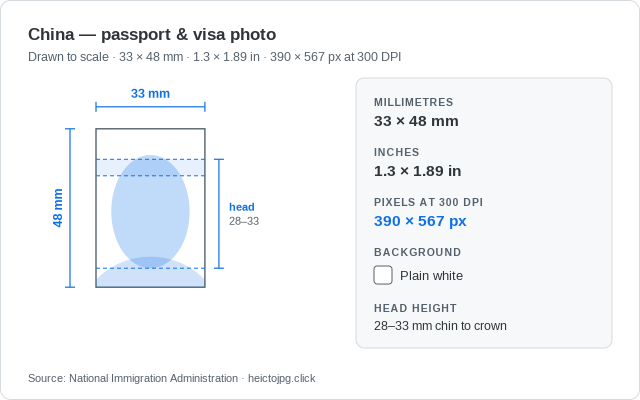
China passport photo size in pixels
There is no separate pixel standard to look up: 390 × 567 px is what 33 × 48 mm becomes at 300 DPI, the resolution ID photos are printed at. Unless a China form asks for something else, export at 300 DPI — a 200 DPI file is the same physical size but fails minimum-dimension checks.
Chinese passport and many visa photos are 33 × 48 mm (about 390 × 567 px at 300 DPI) on a plain white background. That is not the same as the domestic one-inch (一寸, 25 × 35 mm) or two-inch (二寸, 35 × 49 mm) sizes used for IDs, résumés, and school forms.
If you need 一寸 or 二寸, use the ID photo tool presets rather than the passport 33 × 48 mm size. Mixing them up is a common reason photos get rejected at photo shops and online portals.
Digital submissions may require a specific file format (often JPG) and a size cap. Crop to the correct millimeters or pixels first, then compress only if the portal complains about KB.
The 33 × 48 mm frame is the narrowest and tallest on this page, and that shape is the practical catch. A phone portrait cropped to it keeps very little width, so shoulders and stray background creep into the edges in a way they do not at 2 × 2 inches. Frame wider than feels necessary when you take the photo and crop in afterwards, rather than trying to recover the margin later.
Chinese immigration and consular upload validators commonly require a 24-bit sRGB JPEG between 354 × 472 and 420 × 560 px, usually within a 40 KB to 120 KB window. A valid 33 × 48 mm print scan can still fail online if it is outside that pixel range, saved as CMYK, carries a visible border, or was compressed until the hair and jaw edges became blocky. Export directly to the requested dimensions instead of taking a screenshot of a print layout.
Glasses must leave both eyes unobstructed, without dark lenses, heavy reflections, or frames crossing important eye detail; removing them is the safest option when the specific application permits. Religious head coverings may be accepted when the entire face and its outline remain clear, but ordinary hats and decorative headwear are not. Overexposed white clothing merging into the background, beauty filters, altered facial features, red-eye correction artifacts, and shadows beside the ears are recurring reasons a technically correct Chinese photo is refused.
How much of the frame your head has to fill (China)
The size table gets you a correctly shaped file; this is the rule that actually rejects photos. China requires 28–33 mm from chin to crown, which inside this particular frame works out to 331–390 px of the 567 px height — between 58% and 69% of the image.
That percentage is the number worth remembering, because it is what makes a photo non-transferable between countries. A selfie cropped to the right outer size with the head at, say, 40% of the frame is the correct dimensions and still wrong. Crop so the crown and chin land inside the shaded band in the diagram above, and the proportion takes care of itself at any export size.
How to make a compliant China photo
You don't need a photo studio. Take a well-lit portrait against a plain white background, then crop it to the exact size:
- Open the ID photo size tool — it runs in your browser, so your photo is never uploaded.
- Enter 390 × 567 px (or pick a preset) and drag to fit your head inside the frame.
- Export a ready-to-upload file. HEIC, JPG, and PNG all work as the input.
File size: National Immigration Administration and consular portals require a 354 × 472 px to 420 × 560 px JPEG in 24-bit sRGB, typically between 40 KB and 120 KB. If your export is too large, run it through the image compressor to get under the limit without visibly hurting quality.
Before you submit
Dimensions are only part of the requirement. Always confirm the current rules — background color, head height, expression and glasses, and the maximum file size — on the official application before you submit. The size above gets the crop right; the rest is up to your document's guidelines.
Official source: National Immigration Administration